
Bring You The Moon
Installation (2022)
Run Ze Feng
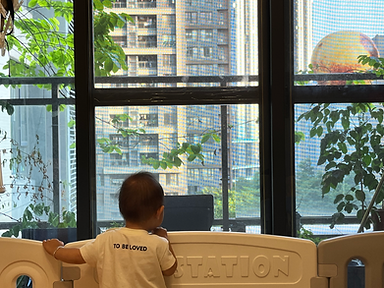
During countless evenings pushing my infant son before he could sit upright, the night sky formed his entire universe from the stroller, with the moon as its brightest exclamation mark — those tiny waving hands and joyful babbling compelled me to repay him with the entire galaxy's tenderness. When successive Mid-Autumn cloudy days declared the sky's absence, a helium-filled "artificial moon" transformed from a private ritual into a public offering: the Bring You the Moon floating installation, initially just a father’s plan B for Kelinhamburg (since the real moon had no chance of appearing), became a communal truth the moment it ascended. As neighbors raised phones to capture the scene — the traditional Chinese symbol of reunion achieved collective nostalgia through an artificial sphere hanging over the rain-soaked city. Gilligan’s care ethics materialized in the night rain: hearing my son squeal at the "moon," I clearly witnessed how others’ yearnings for light resonated in chorus, manifesting as ripples of care extending from kinship care through embracing the other to responding to the world.

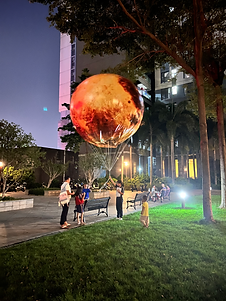

Ultimately, the artwork dissolved itself like a parable: with its strings cut by meddlers, the balloon vanished into clouds, mirroring the eternal struggle of care ethics—the recipients of our extended hands are often lost in transmission. Three months after the helium moon disappeared, news broke of a U.S. F-22 missile obliterating a "stray" Chinese weather balloon, interlocking both events through darkly comedic gears of fate. Within skies defined by human property, simultaneous spectacles unfolded: the childlike innocence of "releasing the moon" against the territorial paranoia and ideological conflicts of the adult world. This departing moon proved its existence through absence: it reminds humanity — the very freedom to release binds us together.