
Cloud Factory
Photography (2025)
Run Ze Feng
The subject matter that 12th-century Chinese ink-wash landscape paintings and 18th-century English gardens sought to imitate was "preistine nature". Yet what I capture through my camera lens today near my Berlin residence represents nature fundamentally transformed by human activity — and unexpectedly, this manufactured nature nearly deceived me.
Here presents a photograph taken through my window, showing Berlin's Mitte district skyline seamlessly blending with cloud formations above. Initially drawn solely by the clouds, I pressed the shutter.

Panning my lens downward, however, I made a startling discovery: what appeared as clouds actually originated from two towering industrial chimneys within the urban horizon. This work documents the process of emissions escaping these chimneys and morphing into "clouds." Undoubtedly, without observing the smokestacks and their connection to these atmospheric formations, I would have unquestioningly attributed them to the pristine nature imagined by most. This raises compelling questions about the true origins of other airborne formations.
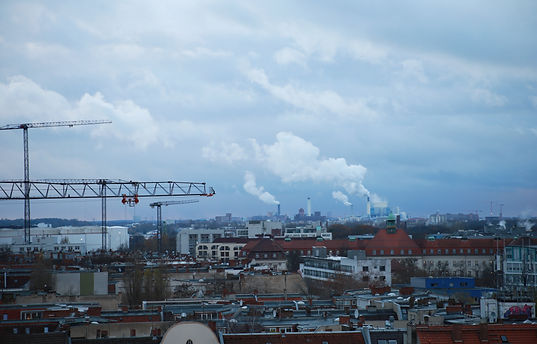
The profoundly unsettling revelation extends beyond mistaken perceptions of nature — it exposes our contemporary inability and apathy toward distinguishing authentic wilderness (or the pristine nature). This represents a critical collective complacency: what appears as pure natural phenomena are now deeply permeated by human production, daily existence, and cultural practices, becoming "natural-cultural hybrids." Yet without visible evidence, society increasingly overlooks such anthropogenic interventions, misinterpreting engineered landscapes as untouched nature. This alarming convergence between cultural amnesia and environmental ambiguity constitutes a dual crisis demanding urgent vigilance.
